Watch the walkthrough
 Teacher video · 2019 P2 Q17
The answer
(a) white \(= 15\), grey \(= 10\) (b) \(62\,500\) (c) \(50.2\%\)
PSLE 2019 Paper 2 Question 17 · Verified worked solution by the Genius Plus Academy teaching team
What this question tests
This is Question 17 of the PSLE 2019 Paper 2 Mathematics paper. It tests number patterns, in the Number & Algebra strand. It is worth 5 marks: 1 + 1 + 3. Open your copy of the paper at this question, then follow our full worked solution below.
Watch the walkthrough
Teacher video · 2019 P2 Q17
(a) Figure 5 adds a 5th row of 9 white triangles to Figure 4: white \(= 6 + 9 = 15\), grey stays \(10\).
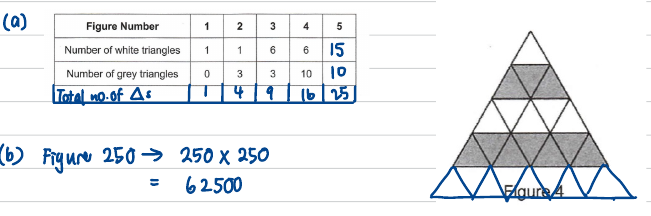
| Figure Number | 1 | 2 | 3 | 4 | 5 |
|---|---|---|---|---|---|
| White | 1 | 1 | 6 | 6 | 15 |
| Grey | 0 | 3 | 3 | 10 | 10 |
(b) Figure \(n\) contains \(n^2\) small triangles: \(250^2 = 62\,500\).
(c) For even figures grey exceeds white by \(n\) (Figure 2: \(3-1=2\); Figure 4: \(10-6=4\); …). For Figure 250: grey \(= \frac{62\,500 + 250}{2} = 31\,375\), so \(\frac{31\,375}{62\,500} \times 100\% = 50.2\%\).
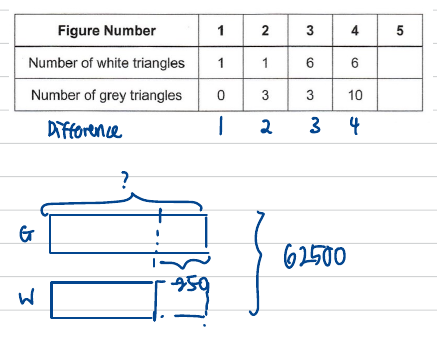
Answer: (a) white \(= 15\), grey \(= 10\) (b) \(62\,500\) (c) \(50.2\%\)
Same structure, different costume
Change egg tarts to badges, a tank to two tanks, a ring of card to a folded sheet, and a child sees a brand new problem. The lock underneath is the same, and so is the key. Once a student can name the structure, a whole row of questions that look different start to open the same way.
It is also where marks really leak. Across fourteen years of papers, the marks lost in PSLE math leak at the reading far more than at the arithmetic, which is exactly why recognising the structure fixes them. We call this Lock and Key: name the lock, then the key follows.
Want more questions like this, with worked solutions?
We will send a set to practise. One email, no spam.
Same skill, different years. Each has a verified worked solution.
Number patterns, worked the same way.
2024 · P1 Q28Number patterns, worked the same way.
2023 · P2 Q11Number patterns, worked the same way.
2022 · P1 Q14Number patterns, worked the same way.
2022 · P1 Q29Number patterns, worked the same way.
2021 · P1 Q12Number patterns, worked the same way.
One of the 10 question types
The PSLE keeps testing the same 10 structures. Our PSLE Math Intensive trains the Lock and Key reflex across all ten, with 158 curated questions over two days.
It is a number patterns question from the Number & Algebra strand, worth 5 marks: 1 + 1 + 3.
Yes. A Genius Plus Academy teacher works it on video above, free to watch.
Yes. Every worked solution here is free to read, with no sign-up wall.
Browse every year from 2014 to 2025 in our worked-solutions library at /resources/solutions/psle/.
Book a free trial and diagnostic. We will look at a real paper and show you exactly where the marks are going.