Read the scale before any bar, and the marks stop slipping · Jump to the worked examples →

Shown working, not just shown off

PSLE data handling questions, shown working.

The short version

Data handling means reading bar graphs, pie charts and tables, then doing real work on what you read. The method is small: read the scale before any bar, find a missing bar by part-whole of the rest, use part-whole on pie sectors, and read across two pictures of the same data. The trap is the hidden scale, where each gridline is worth more than one. Below are two of these questions, solved cleanly and checked twice.

Figures from GPA's tagged index of 709 PSLE questions, on a 664 sat-paper basis, with the MOE Specimen reported separately · every solution worked independently then checked against the verified GPA key · Mrs Eileen Toh signs off the mathematics · last reviewed 22 Jun 2026

How much it is tested

Data handling has quietly grown, from two or three questions a year to five to seven a year since 2018.

It is easy to treat data handling as the gentle part of the paper. The counting says otherwise. When we tagged every question, the number of data handling items rose from a handful a year to a steady five to seven a year from 2018 onward. Across the decade it is one of the most-tested structures, 66 questions in all.

66

data handling questions across the decade, one of the most-tested structures.

5 to 7

questions a year since 2018, up from two or three before.

664

sat-paper questions tagged, from an index of 709 with the MOE Specimen separate.

These are counts from past papers, not a forecast of the next one. Source: GPA tagged index, 664 sat-paper questions, 709-question index with the MOE Specimen reported separately.

How data handling questions work

Read the picture first, then do the arithmetic.

Almost every data handling question is two jobs in one: read a value off a graph or chart, then use that value in a calculation. The marks are lost in the reading, not the sum. Four moves cover nearly all of them.

Read the scale before any bar

Look at the axis label and work out the value of one gridline before reading a single bar. The picture is honest; the eye is not.

Find a missing bar by part-whole

When one bar is left blank, the rest plus a given relationship pin it down. The missing part is the whole minus the parts you have.

Use part-whole on pie sectors

A pie is a whole split into fractions. One known sector fixes the whole, and then every other sector is a part of it.

Read across two representations

When a pie and a bar show the same data, a value you can read on one tells you a value you cannot read on the other.

2017 · Paper 2 · Q6 pie chart and bar graph

One spend, two pictures

Where to find it

This is a worded PSLE question, so we don’t reproduce it here. Find it in your Ten-Year Series (TYS) or the official paper — 2017 Paper 2, Q6, parts (a)–(c) (the pie-chart-and-bar-graph spending question) — then follow our worked solution below.

The lock

Two representations of the same data, and a bar-graph scale where each gridline is worth 10. A careless read of the scale loses marks before any thinking begins.

The key

Read the scale, then use part-whole: one known sector, $80 = 1/5, unlocks the whole.

Worked steps

  1. (a) Clothes \(= \frac{1}{5} = 20\%\).
  2. (b) Clothes \(= 20\% = 80\), so the total \(= 80 \times 5 = 400\). Books \(= \frac{50}{400} = \frac{1}{8}\).
  3. (c) Meals \(= \frac{1}{2} \times 400 = 200\); Transport \(= 400 - 200 - 80 - 50 = 70\).

Answer: (a) 20%. (b) 1/8. (c) Meals $200, Transport $70.

What makes it click. One known sector, $80 for 1/5, fixes the whole at $400. After that, every other amount is just a part of it.

Independently solved, matches the GPA marking-scheme key. Open the full worked solution →
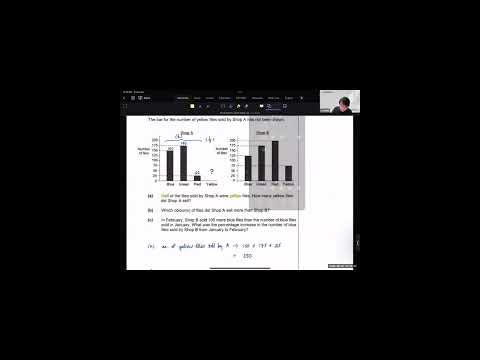
2020 · Paper 2 · Q10 bar graph, missing bar

The bar that is not drawn

Where to find it

This is a worded PSLE question, so we don’t reproduce it here. Find it in your Ten-Year Series (TYS) or the official paper — 2020 Paper 2, Q10, parts (a)–(c) (the bar-graph question with one bar left blank) — then follow our worked solution below.

Video: a Genius Plus Academy teacher solving PSLE 2020 Paper 2 Question 10 Teacher video · 2020 P2 Q10

The lock

A missing bar is found by part-whole, and each later part rests on reading the right values off the graph.

The key

"Half were yellow" means yellow equals the other three added together; then compare, and compute the percentage increase on the right base.

Worked steps

  1. (a) Yellow (Shop A) \(=\) Blue + Green + Red \(= 150 + 175 + 25 = 350\).
  2. (b) Compare Shop A with Shop B: Blue \(150 > 125\); Green \(175 = 175\); Red \(25 < 200\); Yellow \(350 > 75\). So blue and yellow.
  3. (c) Percentage increase \(= \frac{105}{125} \times 100\% = 84\%\).

Answer: (a) 350. (b) blue and yellow. (c) 84%.

What makes it click. "Half were yellow" turns the missing bar into the sum of the other three; the rest is careful reading off the graph.

Independently solved, matches the GPA marking-scheme key. Open the full worked solution →

The trap that costs marks

The hidden-scale misread.

The most common way to lose a data handling mark is to read a bar or axis as if each gridline were worth 1 unit, when the scale is 2, 5, 10 or 20. The arithmetic that follows is then flawless and wrong. The picture did not lie; the scale was simply skimmed.

The fix is a habit, not a talent. Read the scale label before any bar, and pencil the value of one gridline at the side of the graph. With one gridline named, every bar reads itself, and the rest of the question is just the arithmetic you already know.

Free for parents

The 10 PSLE Question Types, cheat sheet

One page that names all ten question types, the lock behind each, and the first move that opens it. Data handling is one of them. One email, no spam.

From one type to all ten

This trains one structure. The Intensive trains all ten.

This guide trains reading hidden scales and part-whole on pie sectors; the PSLE Math Intensive trains structure-recognition across all ten question types, with 158 worked examples.

Keep reading

The full picture this type sits inside, and the structures it leans on.

Pillar guide

Most-tested PSLE Math topics, counted

What 709 tagged questions show the paper rewards.

Worked solutions

The hardest PSLE questions, shown working

Twelve demanding questions, each hard by structure.

Type guide

Percentage questions

Anchor the percentage to the right base, every time.

Type guide

Part-whole questions

Name the whole in units that divide everything cleanly.

Questions parents ask

How much is data handling tested at PSLE?

It has grown. When we tagged every question, data handling rose from two or three a year to a steady five to seven a year since 2018, and across the decade it is one of the most-tested structures, 66 questions in all. These are counts from past papers, not a forecast of the next one.

What is the single most common mistake in these questions?

The hidden-scale misread: reading a bar or axis as if each gridline were 1 unit when the scale is 2, 5, 10 or 20. The fix is a habit, read the scale label before any bar, and pencil the value of one gridline at the side of the graph.

How do you find a missing bar on a graph?

By part-whole. The blank bar is the whole minus the parts you can read, or it is fixed by a relationship in the question, such as "half were yellow", which makes the missing bar equal to the sum of the other three. Once one value is found, the rest is careful reading off the graph.

Are these solutions reliable?

Both worked examples here were solved independently and then checked against the verified GPA marking-scheme key, and both agreed on every answer. Mrs Eileen Toh signs off the mathematics. You can browse more in our worked-solutions library.

See how your child reads a graph.

Book a free diagnostic. We will sit with a real paper and show you which structures your child already sees, and which need work.

Book a Free Diagnostic